
Rogue Nation
Why the Kremlin’s approval of America’s new security strategy should alarm Europe

Soon after Trump was elected for his second term, before the annexation talk about Greenland and the absurdity of Canada as the 51st state, I drafted a script idea. The half-joking pitch to my sceptical family was that America might become the rogue power of the Western story. It began with Trump subverting the democratic process, sidelining Congress through executive orders, loading the Supreme Court and key institutions with loyalists, and going after his enemies.
He had already dimmed the searchlight of the media, but his later attacks on universities and academic freedom went well beyond my stretched imagination. The script ended with America withdrawing from NATO and presenting Europe with a threat comparable to Russia’s… leaving all three superpowers manoeuvring around China.
It was meant to sound melodramatic.
Within weeks, Trump made it appear too mundane to fictionalise.
He began behaving like an authoritarian who had discovered the cheat codes. Treat Congress as optional. Treat the courts as obstacles to be neutralised. Treat the media as an enemy to be disciplined. Treat law enforcement as a political instrument. In a screenplay you would be told to tone it down. In real life, we are watching the consequences of not doing so.
As if a president of a democratic nation could do that. The as-if moment, when the needle finally hits the bullshit and disbelief floods back in.
Yet here we are.
“Trump and Putin: spot the difference” is only settled by the amount of blood on the hands of one. The line claims artistic licence, but it now sits uncomfortably close to a truth we should all worry about. The danger is not only what this does to America. It is what it licences abroad. Once the world’s most powerful democracy starts treating pluralism as weakness, authoritarians elsewhere hear permission in the noise.
Free speech as Trojan horse
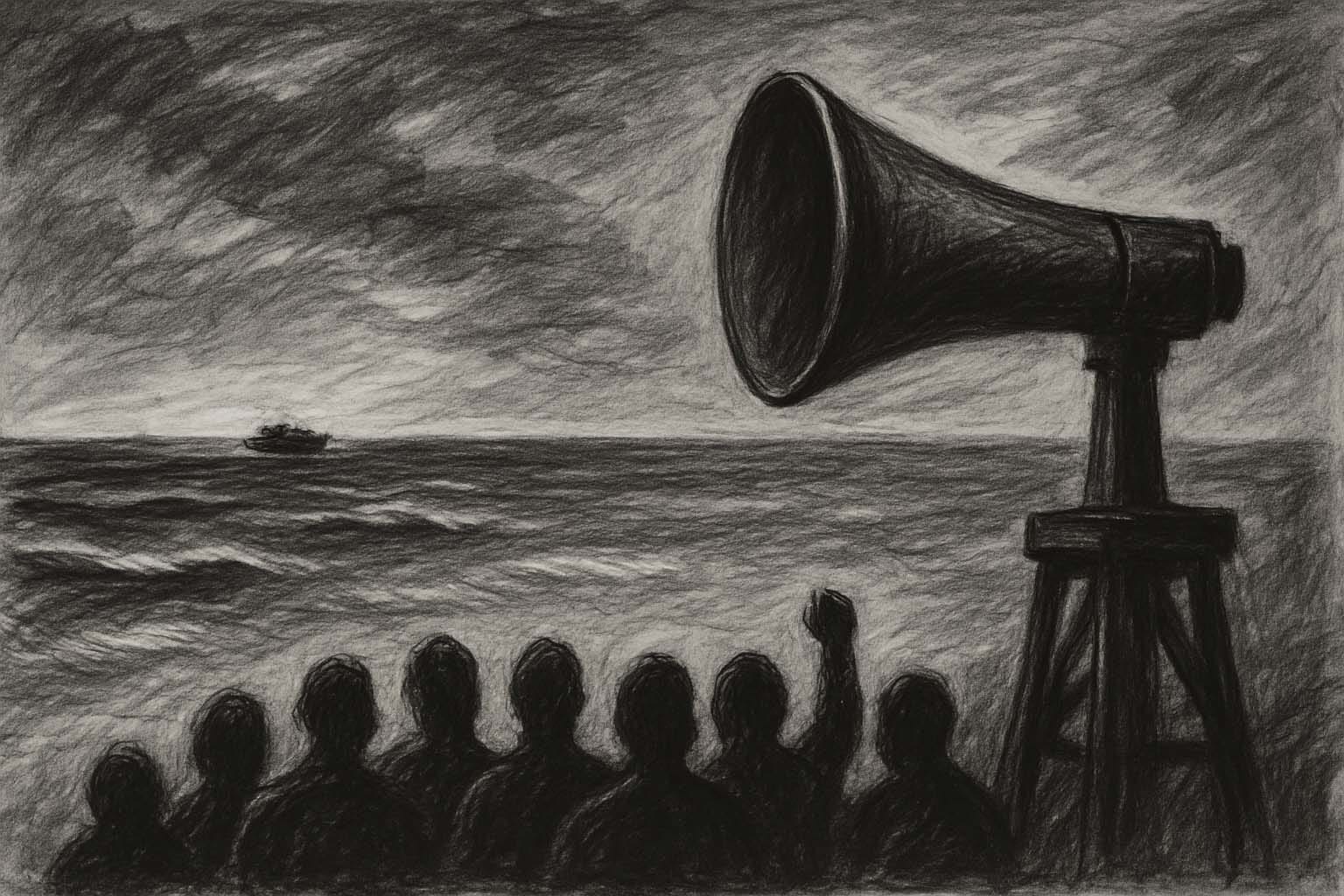
The next move in this story arrives dressed as principle. The right has learned to weaponise “free speech” with real strategic skill. It is presented as a noble defence of Western liberty, but in practice it functions as a Trojan horse. The target is not simply “censorship”. It is Europe’s capacity to regulate powerful platforms, to preserve a common civic space, and to act collectively.
The moment the EU attempts to enforce transparency or accountability through instruments such as the Digital Services Act, the dispute is reframed as tyranny. Regulation becomes repression. Accountability becomes oppression. And the solution is not reform but dismantling the Union itself.
That is why the spectacle of Elon Musk calling for the abolition of the EU, and Dmitry Medvedev replying “Exactly”, matters so much. It compresses the logic into a single exchange. The rhetoric is sovereignty. The payoff is fragmentation. And the beneficiaries are those who would prefer a Europe of pliable states to a Europe that can bargain, sanction and govern as one.¹
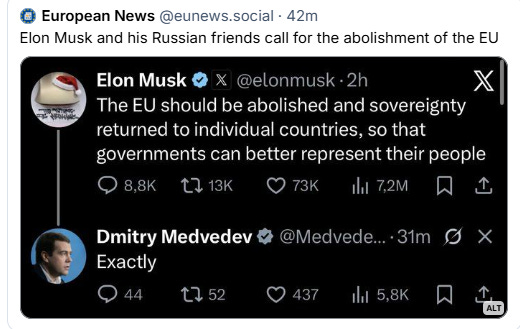
Seen this way, what looks like a culture war is also a negotiating strategy. A strong EU can regulate platforms, coordinate sanctions, bargain on trade, and set rules that even superpowers must respect. A splintered Europe cannot. Encourage the idea that sovereignty means dismantling shared institutions and you do not need to defeat Europe. You only need to disaggregate it. The result is a continent of bilateral relationships where dependence becomes the price of protection, and where ideological alignment can be quietly swapped for market access, security guarantees or preferential status. It is the old imperial logic in a modern suit. Divide to govern, govern to profit.
Immigration, destabilisation and the limits of denial
The language of “civilisational erasure” is not random. It is calibrated to land on the most combustible political fault line in Europe: migration. It speaks directly to fear of demographic change, pressure on housing and services, cultural dislocation, and the sense in many communities that change has arrived faster than political systems can manage it. These pressures are real. To deny that immigration poses genuine challenges to social stability is as unserious as pretending it is the sole cause of every economic frustration.
What turns pressure into crisis is not migration itself, but how it is politically processed. When complex global movements of people are reduced to slogans, invasion metaphors and civilisational panic, migration stops being a policy problem and becomes an identity weapon. That weapon is now being refined at industrial scale on platforms like X, where algorithmic amplification, grievance entrepreneurship and foreign-state disinformation blend into a single emotional current.
This is the danger of the current American posture. By framing Europe’s future through the lens of “civilisational erasure”, Washington is not merely describing a risk. It is stoking the dynamics that strengthen Europe’s most authoritarian political currents. Migration anxiety is already fragmenting EU states electorally, adding fuel to populist parties, hardening borders politically before they harden legally. In that environment, “free speech” rhetoric does not protect pluralism. It protects escalation.
But it is equally dangerous to pretend that immigration is simply an unqualified benefit that requires no coordinated control. In a global system shaped by war, climate disruption, demographic asymmetry and economic collapse, unmanaged migration overwhelms national systems acting alone. This is why the only credible response is European. Border management, asylum processing, burden-sharing, external stabilisation, returns agreements and labour integration cannot be solved at the scale of Italy, Greece, Hungary or Britain operating in isolation. They require continental coordination or they fail by default.
Fragment Europe, and you do not “solve” migration. You turn it into a permanent crisis machine that feeds the very authoritarian movements claiming to oppose it.
The strategy as ideological instrument
This is where the new U.S. National Security Strategy becomes pivotal. It frames Europe’s core problem not primarily as military capacity, but as a crisis of identity and sovereignty allegedly driven by immigration, EU integration and the suppression of “free speech”.²
The most striking move is its explicit call to “cultivate resistance” within European nations against Europe’s “current trajectory”, coupled with warnings of “civilisational erasure” within two decades and praise for the rising influence of “patriotic European parties”.³ This reads less like alliance management and more like ideological sponsorship.
On one track, the Strategy wraps itself in the language of democracy and free speech. On the other, it legitimises parties whose central project is narrowing belonging along ethnic, religious or civilisational lines. The combined effect weakens Europe’s collective political identity while energising its most exclusionary forces.
This is why the Kremlin’s reaction matters so much. Russian officials have openly welcomed the Strategy as aligned with Moscow’s worldview.⁴ When the Kremlin applauds a U.S. “security” doctrine, coincidence stops being a serious explanation.
Britain, Brexit and the laundering of influence
The latest revelations about the Farage-aligned MEP network sharpen this further. Nathan Gill, a former Ukip and Reform figure, has already been convicted of taking pro-Kremlin bribes in exchange for promoting Moscow’s line on Ukraine. At least eight MEPs elected for Ukip or the Brexit Party are now alleged to have followed the “script” he circulated, recycling Russian-aligned talking points on sympathetic foreign media outlets.⁵
The Crown Prosecution Service is careful not to claim that all those MEPs knew about the money or broke the law. But the pattern is hard to ignore. The Brexit ecosystem became one of the arenas in which Russian messaging was laundered through apparently domestic voices.
This folds directly into the unresolved question of interference. The UK Intelligence and Security Committee did not claim it could measure the impact of Russian activity on the EU referendum. What it did say was arguably more damning: the British state never produced a serious post-referendum assessment of attempted interference, despite credible public evidence and open-source research pointing to sustained pro-Brexit messaging by Russian outlets.⁶ When a state refuses to look, the blind spot becomes policy.
Across the Atlantic, the record is harder to wave away. The U.S. intelligence community assessed with high confidence that Putin ordered an influence campaign in 2016, and the Senate Intelligence Committee documented a multi-layered Russian active-measures operation aimed at undermining trust in American democracy.⁷ Later reviews may have debated confidence ratings at the margins, but they have not overturned the central conclusion that Russia sought to shape the political environment in which Trump rose to power.
Brexit and Trump’s rise sit in the background of this story like two unsolved murders in a crime series. The plot can move on, but the motive is still hanging in the air.
Russia as the missing hinge
This is where Russia stops being a side plot and becomes the missing hinge. Trump’s indulgent posture towards Putin is not a diplomatic quirk. It is the foreign-policy expression of a wider contempt for liberal pluralism. The point is not merely to end a war. The danger is that the war is repurposed as a stage for a broader argument that Europe must be rescued from itself.
When the U.S. starts treating Europe’s liberal order as the real sickness and Russia as a manageable fixture in the cure, the challenge to democratic ideals becomes systemic. Freedoms are hard won and easily abandoned when political emotion is redirected towards an imagined internal enemy. The rhetoric promises restoration. The method is coercive simplification. The outcome is a narrower idea of who belongs.
Russia does not need a formal alliance to benefit from this logic. It only needs the West to fracture itself.
On repetition, sentiment and the structure of the loop
At this point I am conscious that I am circling familiar ground. Different essays, different triggers, different entry points - and yet I keep arriving at the same hard knot: Russian involvement, the promotion of social and economic division, and the mobilisation of those divisions as cover for authoritarian politics. That repetition is not an accident of my thinking. It reflects the structure of the problem itself.
These issues overlap because they are designed to overlap. Migration anxiety, culture-war rhetoric, economic grievance, platform amplification and institutional distrust are not separate crises that coincidentally touch. They are braided together to shape political sentiment at speed and at scale.
One of the earliest themes of my Substack, and before that, the Skinhead research, was precisely this danger: that sentiment, once fully mobilised, drowns out deliberation. People stop arguing about policy and start defending emotional positions tied to identity, belonging, humiliation and fear. Logic does not disappear, but it becomes politically secondary. That is the environment in which authoritarian politics thrives. Not by persuading, but by saturating.
If these arguments now feel recursive, it is because the strategy itself is recursive. The same emotional levers are being pulled again and again, across borders and platforms, because they continue to work.
Unity as the counter-move
This brings the argument to its strategic core. If disinformation and discord are now being exported into Europe at superpower scale - through ideology, platforms, money and state-aligned messaging - then European unity is no longer a bureaucratic preference. It is a security necessity.
That requires three recognitions.
First, Europe cannot defend itself against destabilisation while pretending that the first Trump victory and the Brexit vote emerged in a geopolitical vacuum. Russian interference is not an embarrassment to be filed away. It is part of the causal architecture of the present.
Second, European coordination in defence, procurement, intelligence and economic leverage is not a federal fantasy. In a world of continental-scale powers, sovereignty without scale is just exposure with a flag.
Third, Britain is weaker outside this structure than within it. Economically, militarily and diplomatically, Europe is stronger with the UK inside the collective framework than performing dependency theatre outside it. The more the Reform ecosystem is exposed as aligned, directly or indirectly, with Russian strategic interests, the harder it becomes to maintain the fantasy that Brexit enhanced British autonomy rather than trading it down.
In a rational world.
Trump’s America is not merely pursuing national interest in a traditional great-power sense. It is exporting a method: disinformation fused with sentiment politics, identity panic framed as civilisational defence, institutional weakening presented as sovereignty. When the Kremlin applauds that posture, when Farage-linked figures recycle Russian scripts, when “free speech” becomes the alibi for platform dominance and EU dismantling, the phrase “rogue nation” stops sounding like satire.
It starts to sound like diagnosis.
Endnotes
European Commission, Digital Services Act enforcement action against X, 2025; Medvedev response reported by TASS, 2025.
The White House, National Security Strategy of the United States, 2025.
Henley, J., “‘Cultivate resistance’: policy paper lays bare Trump support for Europe’s far right”, The Guardian, 2025.
Peskov quoted in The Guardian, “Kremlin hails Trump strategy as aligned with Russia’s vision”, 2025.
The Guardian, “Farage-bloc MEPs alleged to have followed Russian asset’s script”, 2025.
Intelligence and Security Committee of Parliament, Russia Report, HC 632, 2020.
U.S. Senate Select Committee on Intelligence, Russian Active Measures Campaigns and Interference in the 2016 U.S. Election, Vols I–V, 2020.